Hundreds of thousands of patients living in the United States travel to Latin America every year for treatment. They do not do it because they distrust American doctors. They do it because a dental implant, a hip replacement, a rhinoplasty, or a gastric sleeve can cost 50% to 80% less at accredited private clinics in Mexico, Colombia, Costa Rica, or Panama — and because a copay, a high deductible, or a gap in coverage can turn the U.S. price into a real barrier. Crossing the border, or taking a three- to six-hour flight, is not an impulsive choice. It is a rational response to a system where hospital costs are among the highest in the world.
In 2026, traveling for medical care is no longer an adventure reserved for people who know someone in Tijuana or Medellín. It is a structured alternative, with verifiable international accreditations, prices you can compare in dollars, and digital tools that let you make informed decisions before you book a flight. Specialized platforms such as KURBUO have helped change that process: what once depended on a social-media ad or a friend with contacts can now be managed with more transparency, from the first virtual consultation through postoperative follow-up.
This article covers what you need to know to understand how the sector works, which procedures drive demand from the United States, which destinations patients choose, and how to organize the process with real safeguards.
What medical tourism is — and how it differs from wellness travel
Medical tourism vs. wellness tourism: two different ideas
Medical tourism means traveling to another country specifically to receive treatment, surgery, or a diagnosis. Wellness tourism, by contrast, covers trips focused on prevention, rest, or general well-being: spas, retreats, thalassotherapy. The distinction matters because it has direct consequences for paperwork, travel insurance, logistics, and, above all, the clinical decision behind the trip.
Someone who travels for a dental implant in Los Algodones or plastic surgery in Bogotá is making a medical decision that involves a clinical history, a written surgical quote, and postoperative follow-up. Someone who travels to a spa in Costa Rica is planning a vacation with a health component. Mixing up the two terms leads people to underestimate how much preparation a therapeutic trip requires.
Latin America’s medical tourism market is estimated at about $14.61 billion in 2026. Mexico receives between 1.2 and 3 million medical travelers a year, most of them from the United States and Canada. Typical savings for a U.S. patient fall between 40% and 80% versus U.S. prices, depending on the procedure and the destination.
What a well-structured medical trip includes
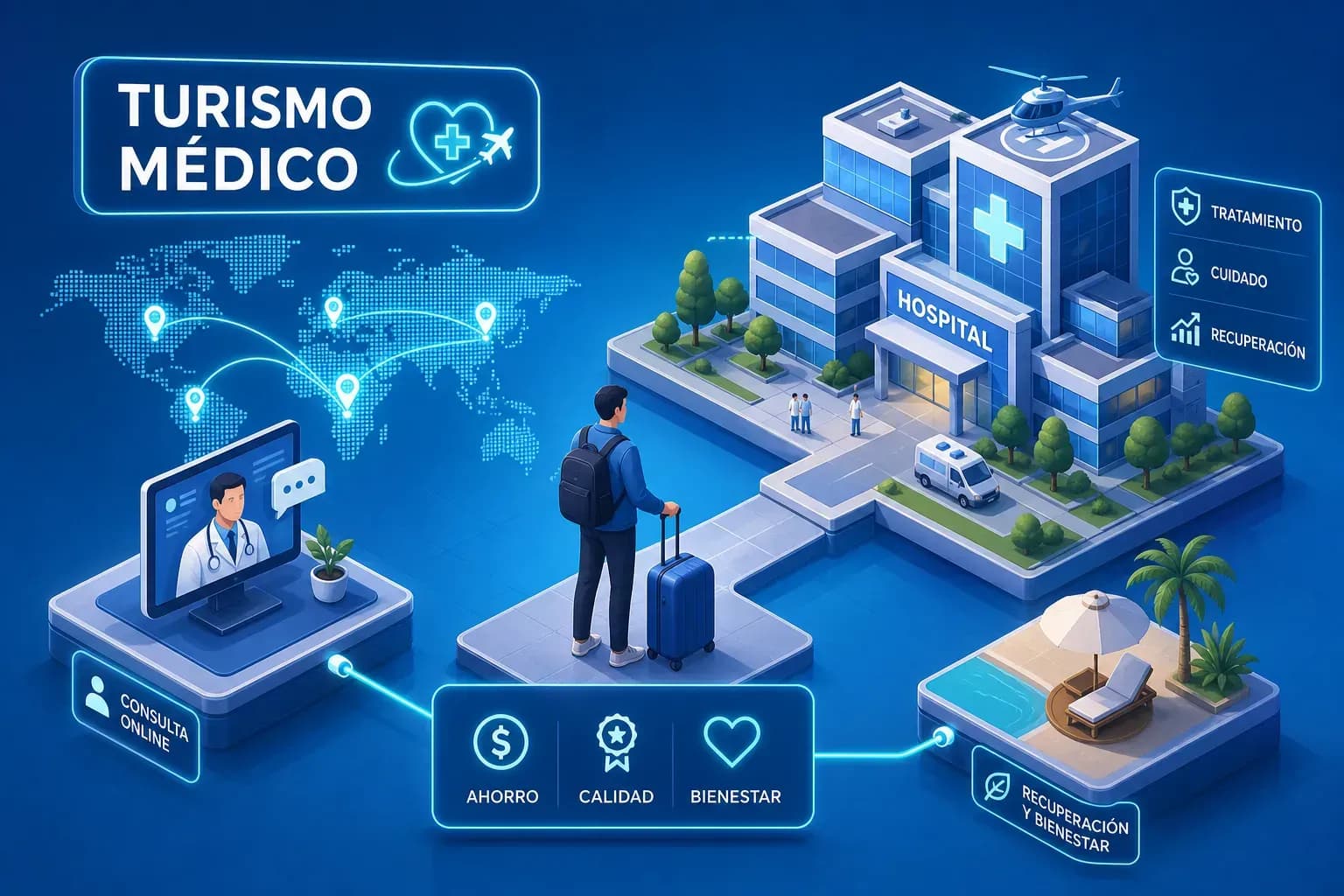
A well-organized process does not start at the airport or end at hospital discharge. It starts when the patient looks for information and compares specialists, and it ends when the physician confirms that recovery is going as expected. Between those two points, the essential pieces are:
- A prior teleconsultation with the specialist at the destination
- A diagnosis and a detailed written quote (ideally as an all-inclusive package)
- Coordinated travel and lodging
- Treatment or surgery at the chosen facility
- Recovery at the destination under medical supervision
- Clinical follow-up after returning to the United States
A poorly planned medical trip ends up costing more than a well-managed one, even when the procedure itself is cheaper. The difference between a worthwhile process and a problematic one usually sits in the preparation phase, not in the execution.
The patient profile choosing this option in 2026
Who travels, and why they decide to go
Mexico accounts for most of the flow: recent estimates put patients from the United States and Canada at more than one million in a single year. Costa Rica receives around 70,000 medical tourists a year, more than 80% of them from the U.S. Colombia and Panama attract a growing volume of cosmetic surgery, orthopedics, and highly specialized procedures.
Looking at the sector, four common profiles stand out:
- Patients aged 40 to 70 with a high-deductible plan or incomplete coverage who cannot absorb a U.S. hip or knee replacement in one payment
- People aged 25 to 55 looking for a cosmetic, bariatric, or dental procedure at a much lower cost than private U.S. clinics
- Anyone who needs an international second opinion or oncology or highly specialized care with shorter wait times
- Hispanic residents in the U.S. who combine a family visit with medical care in Mexico, Colombia, or another country of origin
What all of these profiles share is the same underlying need: access to a trusted specialist without paying the full U.S. price, with clear safeguards and without giving up clinical safety. That demand is not a passing trend. It is a logical response to a system with very high hospital costs and uneven coverage.
The procedures in highest demand and indicative prices
The treatment groups that concentrate most travel from the U.S. to Latin America are dentistry and implantology, cosmetic surgery (rhinoplasty, liposuction, breast augmentation), bariatric surgery, ophthalmology (LASIK, cataracts), and orthopedics (hip and knee replacement).
Reference prices in the United States (typical national ranges, uninsured or before plan adjustments):
- Single dental implant: about $3,500–$5,000 (national average near $4,500 without insurance)
- Rhinoplasty (all-in): $7,000–$15,000
- Hip replacement: $32,000–$60,000 depending on facility and state
- Knee replacement: $30,000–$50,000
- Gastric sleeve: $15,000–$25,000
- LASIK (per eye): around $2,000–$2,500 on average
In established Latin American destinations, the same procedures often fall in ranges like these (packages at reputable private clinics, 2025–2026):
- Dental implant: $750–$1,200 in Mexico, Colombia, or Costa Rica (typical savings of 70–80%)
- Rhinoplasty: $3,000–$5,500
- Hip replacement: $11,000–$15,000
- Knee replacement: $10,500–$15,000
- Gastric sleeve: $4,000–$6,500
- Full-mouth restoration / All-on-4: $7,500–$13,000 versus $30,000–$45,000 in the U.S.
Those figures are a reference, not a locked-in quote. Real savings depend on the specific procedure, the destination, whether the package includes hotel and transfers, and airfare. The pattern, however, is consistent: the same procedures cost 50% to 80% less in leading Latin American destinations, including hospitals with international certification comparable to U.S. or European standards.
Real advantages — and the risks to manage before you book the flight
The savings are real, and the data backs that up
The price gap between a procedure in the United States and the same procedure in Mexico, Colombia, or Costa Rica does not automatically mean a quality gap. It reflects differences in cost of living, wages, hospital cost structure, and the absence of the same administrative billing layer. In dental implantology, typical savings sit between 70% and 80%. In orthopedics and bariatric surgery, between 60% and 80%.
The 70–80% savings figure applies to certain procedures and destinations, not uniformly to everything. Gross savings should always be weighed against the real costs of travel, lodging, time off work, and specific insurance. For a patient in the U.S. Southwest, a short flight or a land crossing into Mexico makes the all-in math especially favorable. When that full calculation is done honestly, the result is still favorable in most cases — but it should be done before any decision is made.
Risks to manage, not ignore
The most common risk is choosing an unverified provider — especially in high-volume border corridors — which can lead to postoperative complications with no coverage and no follow-up after returning to the United States. Other frequent mistakes include failing to budget for a possible complication after you get home, assuming U.S. insurance will cover checkups or revision surgery, underestimating the language barrier at some clinics, or not knowing what happens if the clinical result falls short of expectations.
The U.S. Department of State and the CDC state clearly that foreign health systems are not subject to the same rules as those in the United States, and they recommend consulting your primary physician before you travel.
These risks are reduced by choosing facilities with recognized international accreditations, buying specific travel insurance with high limits (many packages recommend at least $50,000–$100,000 in emergency medical coverage valid in the destination country), and working with coordinators or platforms that vet specialists before the patient commits. A well-managed process can bring uncertainty down to a level comparable with any self-pay procedure in U.S. private care.
The destinations U.S. patients choose most — and what makes them attractive
Why Latin America leads demand from the United States
Mexico, Colombia, Costa Rica, Panama, and Brazil account for most medical-tourism flows leaving the U.S. for the region. The reasons are straightforward: geographic proximity (especially Mexico), direct flights, much lower costs, highly trained specialists at top-tier private facilities and, for millions of Hispanic residents, shared language and cultural affinity.
- Mexico leads on volume and proximity: dentistry (Los Algodones, Tijuana, Cancún, Mexico City), bariatric surgery, and cosmetics. It receives the largest share of U.S. medical travelers.
- Colombia stands out in plastic surgery, orthopedics, and, increasingly, high-complexity procedures. Fundación Santa Fe and other centers in Bogotá and Medellín appear regularly in regional rankings.
- Costa Rica has a solid reputation in dental implantology and general surgery; more than 80% of its medical tourists arrive from the U.S. Hospital CIMA is among the facilities with additional recognition for international patients.
- Panama offers infrastructure built for international patients, a dollarized economy, and affiliations such as Hospital Punta Pacífica with Johns Hopkins Medicine International.
- Brazil is a regional and global reference in cosmetic surgery.
Inside each country, quality varies widely from one facility to another, which is why every provider should be verified individually before you commit. Proximity is not a substitute for accreditation.
JCI accreditation: the seal an informed patient should not ignore
Joint Commission International is the clearest benchmark for assessing the clinical quality of a hospital outside the United States. JCI accreditation means the facility was evaluated independently and, at the time of certification, met international standards in areas such as infection control, surgical safety, medication management, and clinical governance. Accreditation is valid for three years and requires periodic recertification.
To check whether a Latin American clinic has current JCI accreditation, the patient can request the facility’s exact legal name and confirm it in the official Joint Commission International directory, ask the clinic to show the Gold Seal of Approval on its website or at admission, and ask directly whether the accreditation covers the specific service they will use. KURBUO works with a network of specialists and facilities that, according to information provided by the platform itself, are verified under these standards — which can reduce the research burden that would otherwise fall on the patient.
How to plan your medical trip with safeguards: steps, paperwork, and tools
The documents and formalities worth sorting out in advance
A U.S. citizen or resident traveling to Latin America for medical care needs, at a minimum:
- A valid U.S. passport for the entire stay (at least six months of remaining validity is advisable in several destinations)
- A medical report from the home specialist that documents or supports the treatment
- Written confirmation from the destination facility with dates, expected length of stay, and a quote
- Travel medical insurance with emergency coverage valid in the destination country
- If traveling with medication, a prescription that includes the prescriber’s details
Typical entry rules for U.S. passport holders (always verify before travel; rules change):
- Mexico: no visa required for tourist stays of up to 180 days; travelers complete the immigration form (FMM). The receiving facility may request additional documents if the purpose is medical treatment.
- Colombia: no visa required for stays of up to 90 days (extendable). Complete Check-Mig before the flight and carry a return ticket.
- Costa Rica and Panama: no visa required for typical short stays (around 90 days; Panama can be longer). Some checkpoints ask for proof of onward travel.
- Brazil: since 2024, U.S. citizens generally need an electronic visa.
If the patient travels with a companion or is a minor, paperwork expands to include consents and proof of the accompanying adult. Dual nationals should travel with both passports when the destination country requires it.
The role of digital platforms in the new era of medical travel
The “Instagram ad and a WhatsApp group” model is no longer enough. A 2026 patient can filter specialists by country, language, specialty, and other patients’ reviews before making any clinical decision. They can hold an encrypted high-definition teleconsultation with a surgeon in Mexico City, Bogotá, or San José from home in Houston, Los Angeles, or Miami, receive a detailed quote, and compare it with other options — all before buying a plane ticket.
KURBUO operates in exactly that space: a platform that combines a network of verified specialists, encrypted high-definition teleconsultations so decisions can be made before travel, and a personal care manager — the Care Navigator — who accompanies the patient from the first consultation through postoperative follow-up. For a patient living in the United States, this mix of clinical verification, personal support, and digital tools lowers the main barrier that stops many people from taking the first step: uncertainty about whether they can trust what they are choosing. If you want to review specialists or book a no-commitment first virtual consultation, the KURBUO team can guide you from the start.
Before you book the flight, have the consultation
International medical tourism in 2026 is not a high-stakes bet for the daring. It is a structured alternative, backed by international accreditations and digital tools that make the process as manageable as planning any other trip. Latin America’s medical tourism market is estimated at more than $14 billion in 2026, and the flow of U.S. patients — especially to Mexico — continues to be driven by verifiable prices and proximity.
What has changed is not demand; that has existed for years. What is new is access to verified information, audited specialists, and support that turns a difficult decision into a manageable process. Whether you are weighing a second opinion, dental implant treatment, a gastric sleeve, or cosmetic surgery with safeguards, the first step is always the same: get informed early and choose with judgment.
Starting with a first virtual consultation — no pressure and no prior commitment — is the most sensible way to begin. Your next step does not have to be a flight. It can simply be a conversation with the right specialist.